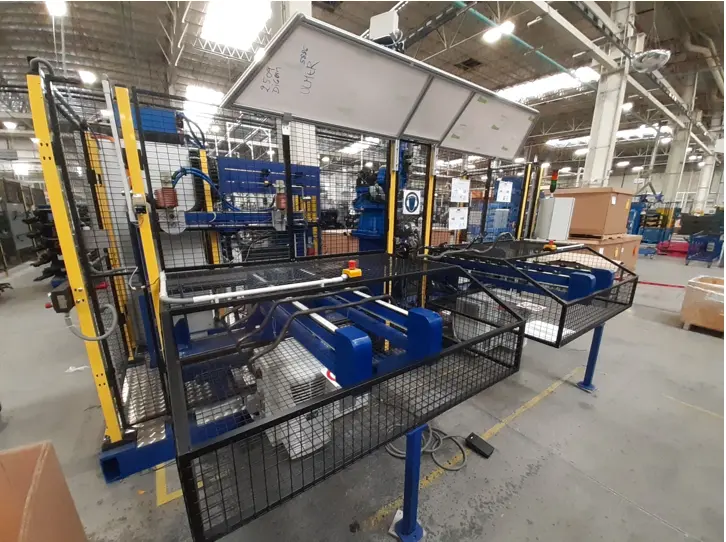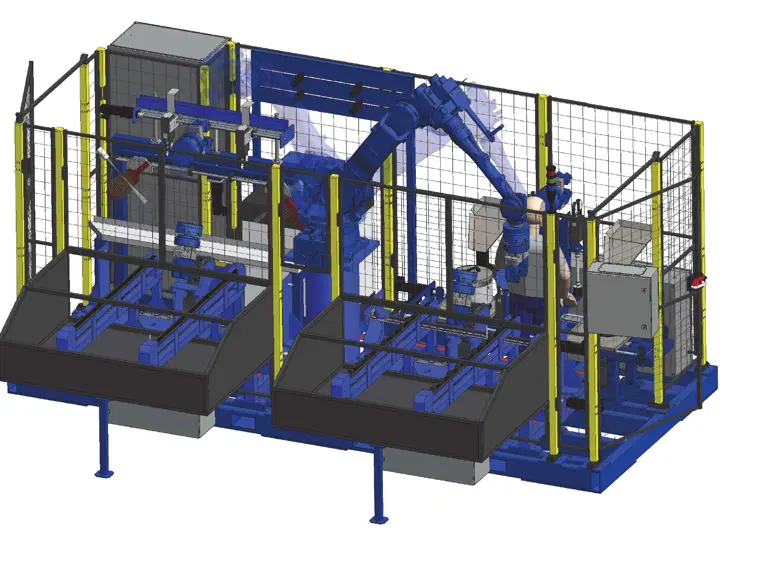
An automated robotic workstation designed for coating the ends of stabilisers (torsion bars) using the dip-coating method. The aim of the project was to replace the existing manual process, improve the quality of the resulting surface and streamline production capacity.
Process description
- Automated loading
The material is fed through an input conveyor, where it is aligned and prepared for subsequent operations. This step ensures a smooth process and minimises the possibility of damage to parts. - Dip dyeing
The robot picks up the stabilisers and moves them to the dyeing station, where their ends are dipped into a special dye. This process ensures that the dye is applied evenly to all the required areas. - Vibratory shaking
Excess paint is shaken off at the vibratory station, ensuring optimal coating thickness without excessive build-up. This step is crucial for achieving the desired appearance and functionality of the surface. - Waiting station and heating
Stabilisers pass through a waiting station where the paint is dried. The coating is then accelerated by induction heating, which ensures a rapid drying process without compromising surface quality. - Output conveyor
Finished stabilisers are transferred to the output conveyor for further processing or packaging, ensuring a smooth flow of the production process.
Benefits and new features of the solution
- Automation: The dyeing process, which was previously carried out manually, is now fully automated, significantly increasing efficiency and consistency.
- New dyeing and colour mixing system: We have developed a special mixing system that is easy to clean and ensures perfect dyeing quality.
- Induction heating: The heating technology has been developed for a wide range of stabilisers, ensuring flexibility and high productivity.
- Material savings and increased safety: Precise paint dosing and elimination of workplace contamination contribute to sustainability and safety in the workplace.
- Increased capacity and quality: Automation brings a significant increase in production capacity and standardisation of the quality of the resulting surfaces.